Mr. Gomez’s Story
Mr. Gomez lived idly in a solitary confinement prison cell, isolated from the prison’s general population, for most of his 14-year sentence. Roughly 55,000–62,000 Americans are housed in solitary confinement, where they experience social isolation, enforced idleness, minimal time out of cell, and often are deprived of most activities like TV and books.* Long-term isolation is often used in prisons for people who pose a danger to themselves or others, have persistent disciplinary infractions, including violence, or for those who self-isolate out of fear for their safety. In isolation, Mr. Gomez was given one hour out of his cell each day, generally for a shower and time alone in an outdoor cage. Any time he left his cell, he was escorted and restrained with his hands bound around his waist and with his ankles shackled. “So I wouldn’t go crazy, I would draw stuff. And paced up and down the cell to wear myself out so I would be able to sleep at night.”
Amend’s Intervention
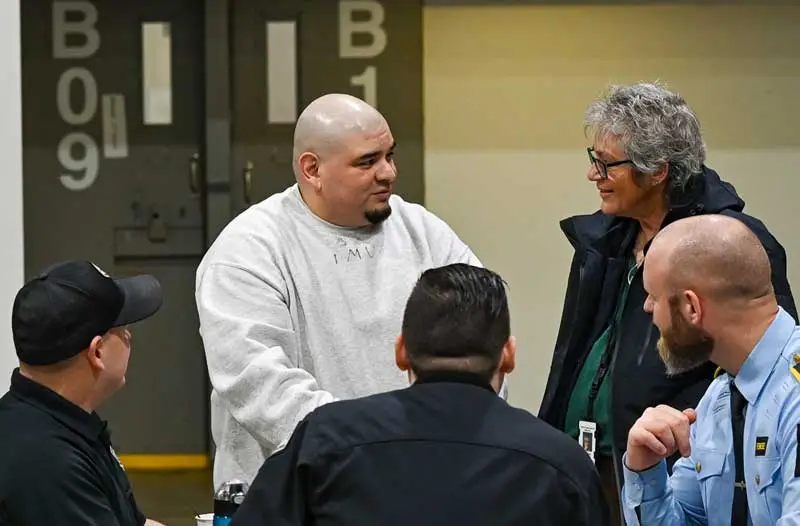
Life for Mr. Gomez started to change after his prison partnered with Amend to establish a Resource Team, a specialized, interdisciplinary group of prison staff that works with high-risk, high-need people in solitary confinement to increase meaningful time out of cell. The Resource Team also helps people re-engage in social activities with the goal of transitioning them to more traditional prison living units (or the outside community) as soon as possible. The Resource Team at the prison where Mr. Gomez was incarcerated is unique compared to other programs because it is open to nearly everyone in the isolation unit, including people like him, whose gang affiliation barred him from most of the prison’s programming.
When Mr. Gomez first heard of the Resource Team, he was at the end of his sentence. He had spent time in almost every isolation unit in his state prison system. He was interested in learning about the Resource Team, but had reservations because of negative interactions he had experienced with prison staff over the years. For the last year of his sentence, Mr. Gomez met with the Team weekly for several hours to talk, socialize, and set goals for his reentry. The Team quickly determined that his restraints could be removed, which meant he could hold a cup of coffee, draw, and play games like cornhole, cards, and dominoes while he was out of his cell working with the Team. As much as he enjoyed the freedom of being unrestrained, it took time for it to feel natural and for him to believe that the Resource Team was there to help him.
“In the beginning when they took off [the restraints] it felt weird because I thought I was going to be set up. I didn’t even move…I was looking for the SWAT Team… Never in my life did I think I would experience being out of restraints in the solitary confinement unit.”
During the year that he worked with the Resource Team, Mr. Gomez became increasingly comfortable talking with others, which had been difficult after so many years of isolation. This allowed him to form and maintain human connections, he said, an experience lacking for most people in isolation. The Resource Team also helped him with critical reentry activities like preparing for his written driver’s test so he would be able to drive himself to employment opportunities.
“For the first time, I felt like I was getting treated like a human being, to be honest. For the first time, after all these years locked up. And I’m really grateful for that.” -Mr. Gomez
The Outcomes
Mr. Gomez was released directly from the prison’s isolation unit to the community. He found a job at a restaurant days after he left prison, an experience that he says would have been nearly impossible if he had not been given the opportunity to engage in conversations during his last year of incarceration. When asked what was most helpful about working with the Resource Team, Mr. Gomez responded: “[It] was the socializing. I was very isolated before. Now out here [outside prison], even at work they’re always saying…you’re always talking [personable]. And it helped me a lot. If I wouldn’t have had that, I would have been still very isolated—not speaking to people [when I was released]. That part right there, was very helpful for me.”
What’s Next
Amend aims to inspire, teach, and collaborate with prisons to reduce harm and create safer, healthier, and more supportive environments. The Resource Team and Mr. Gomez’s experience show that it is possible to immediately reduce harm in carceral environments, particularly in areas of profound isolation, and that safety and security can coexist — and even improve — with enhanced humanity and compassion.
*Cloud DH, Haney C, Augustine D, Ahalt C, Williams B (2023) The resource team: A case study of a solitary confinement reform in Oregon. PLoS ONE 18(7): e0288187. https://doi.org/10.1371/journal.pone.0288187