Ms. Riley’s Story
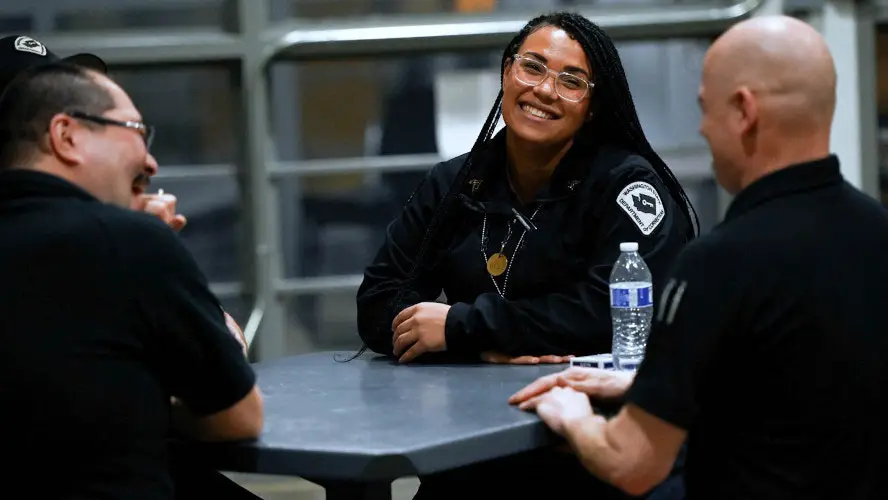
Kabrina Riley felt a lot of pride when she began working in the Washington Department of Corrections in 2017. “It meant something to be putting on that uniform every day.” But eventually, Kabrina approached prison work with a hardened mindset, born out of self-preservation and years of mistreatment in her previous job in a different social sector. She was strict and unyielding, a self-described “jerk” who enforced the rules without discretion. “I picked every battle.” In 2021, Kabrina’s workplace, the Washington Corrections Center for Women, began to partner with Amend to introduce international best practices focused on dignity and health in prisons. She was resistant to the concepts, but over the course of her partnership with Amend, her outlook changed. She realized the approach she was taking was undermining her well-being and the health and dignity of incarcerated people, and that she could be more effective at supporting people to change their lives for the better while creating a safer prison environment and finding purpose in her work.
“We’re not here to punish. That’s not our job. My job is to help people learn and grow. I didn’t used to understand that. I do now.” – Kabrina Riley, Corrections Sergeant
Amend’s Intervention
In 2022, Kabrina was given an opportunity that changed the trajectory of her career: a chance to participate in an Amend-led immersion program in Norway and Sweden — countries renowned for humane treatment in prisons, leading to low levels of recidivism. During the immersion trip, Kabrina met Dr. Brie Williams, Director of Amend, who talked about the interrelationship between the health of officers and incarcerated people, and the sense of meaning that officers can find when they support incarcerated people in changing their lives for the better. “I got goosebumps. I got fired up. It all clicked for me.” The experience made her reflect on how people are treated in prisons and the negative impact of those practices on their reentry to society. She returned to Washington with a renewed sense of purpose, determined to bring and adapt the Norwegian and Swedish principles to her work.
Back at her facility, Kabrina co-developed the Quest: Mobile Activity Team, a multidisciplinary team that targets individuals in both restrictive housing and a general population setting who struggle with high-risk behaviors and need support to cope with life in prison. The program started small, but after two years developing and piloting the program, while balancing many 16-hour days as a Sergeant, Kabrina’s work paid off. And in July 2024, the team became a permanent, full-time program in the facility.
The Outcomes
The impact of the Quest: Mobility Activity Team has been profound. One of the first people Kabrina worked with was a young woman with a history of explosive behavior and abusive language. Over four months, Kabrina and her co-lead, a Case Manager, helped this young woman develop healthier ways to communicate. By the end of their time together, the woman had stopped cursing at staff, earned privileges for good behavior, and passed her food handler’s permit exam, a requirement for individuals working in the food industry — becoming one of the first individuals in the state to do so while incarcerated. Kabrina’s work has brought more staff into rehabilitative work; they’re eager to participate in the Quest: Mobile Activity Team and other innovative programs aimed at improving the culture and safety within the prison. Kabrina herself has undergone a profound personal transformation: now she feels like she’s helping people, contributing to her community, and is more satisfied at work and happier at home, too.
“This work has changed my life, not just my job. I want everyone to experience the level of support, empowerment, and purpose that I feel when I come to work every day.” – Kabrina Riley, Corrections Sergeant
What’s Next
Kabrina’s vision for the future is to expand the Quest: Mobile Activity Team and similar initiatives to reach more individuals within her prison system. She hopes to empower other staff members to adopt this humane approach, transforming not only the lives of the incarcerated but also the work environment for correctional officers. “This work has changed my life, not just my job,” Kabrina reflects. “I want everyone to experience the level of support, empowerment, and purpose that I feel when I come to work every day.” Amend aims to inspire, teach, and collaborate with prisons to adapt best practices for their own environment. Kabrina is a shining example of the positive impact this work can have on prison staff and of the possibility of a better professional experience when humanity and dignity are infused into the correctional profession.